Simply put, Growth comes from either acquiring more users or retaining existing users and most importantly showing a sustainable positive impact to profitability.
Acquiring users can be broken down into a) acquisition, getting new users to sign up or bringing back churned users and b) monetization, converting them to paying users.
Retention is all about ensuring these users find the value they paid for and intercepting the churn to keep the revenue flowing.
Clearly defining and measuring Acquisition and Retention for your product can help identify the leaky bucket(s) in your product.
💡 There are several frameworks from Growth experts that break down these concepts into detailed Growth funnels. Don’t fall into the trap of trying to fit a framework to your product to understand these concepts. It must be the other way around.
💡 Take the time to understand your product and user growth as there is no one size fit all. If you’re a Product Manager or Founder this should be your only obsession.
Principle 1: Understand your User growth
By splitting your user growth you can easily identify the leading drivers to growth (positive or negative) and where to invest.
- Defining Active: An action taken by a user to indicate they found value on the product. The most important and hardest part of this equation is finding that indicator of value on the product. If it’s some top of the funnel action such as app opens or viewing a page it would dilute your understanding of user growth and if it’s some bottom of the funnel action such as checkout or clicking a button you could be missing some passive user value indicators such as headline skimming and scrolling which can still keep users coming back to seek value.
💡 Place your monetization strategy next to the value indicator. More on this in Principle 3 below.
- Daily Active User: A unique active user on a given day. This user can either be a
- New user: Active for the first time ever.
- Returning user: Active yesterday and active today.
- Daily Churned user: A unique user active yesterday but not today.
- Instead of using daily as your time period, use a weekly or monthly time period if there is high variability in daily user traffic such as users using the product more on weekends or towards the beginning of the month. Make sure to adjust the time period appropriately in the above concepts. For instance if you use a Weekly time period
- Weekly Active User: A unique active user in the week.
- New user: Active for the first time in the week.
- Returning user: Active in the prior week and active this week.
- Weekly Churned user: A unique user active in the prior week but not this week.
- Weekly Active User: A unique active user in the week.
- Counting your Active Users: Which ever time period you use the formula for active users is the same.
Active Users (AU) = New + Returning - Churned
This sounds pretty straightforward but can get really tricky if you don’t have a team investing in Data Quality. Common things to look out for
- Have consistent and conformed logging events.
- Always count unique users and not absolute number of Active events taken by a user.
- Filter out bots and web scraper traffic that can inflate your numbers.
- A user should be in one state - New/Returning/Churned in a given time period.
Principle 2: Is my problem, Acquisition or Retention?
Let’s say the number of Active Users is on the decline and after breaking down the numbers you notice there is an uptick in both New and Churned users that’s contributing to the decline.
You’re probably thinking we have a retention problem and deploy the standard retention playbook tactics - offer a discounted price, provide more services, free upgrades, etc
While the retention problem could still be very true it’s also possible the users acquired in the first place are not inherently retentive, perhaps a paid marketing program that drove a bunch of short lived user traffic that came seeking for something specific, found it and then left. E.g. promotion to watch the season finale of Game of Thrones → the series ended and the users left.
This now starts to smell of an acquisition problem in that the users being acquired may not be aligned with the Product value and the $ spent here are not sustainable.
💡 Remember to always break down your New and Returning users by referral traffic such as organic, social, paid, marketing and have an on-boarding flow that can tell why the user joined.
💡 Having entry and exit surveys in the off-boarding flow can help understand why the user Churned
This is a classic example of Growth hacking where one team is focused on an Acquisition metric and the other on a Retention metric and both teams end up forming a vacuum chamber focused on metrics alone.
When you think of it as one Product team responsible you start to look at the whole funnel cohesively and are able to turn the nobs of New/Returning/Churned strategies as needed.
💡 Acquisition and Retention almost always go hand in hand
Principle 3: Active Users are growing but not Paying users
Let’s say your Active User (AU) growth is increasing steadily but you don’t see this translate to Revenue growth i.e. monetized users.
Conventional wisdom here would suggest let’s run some experiments on the monetization page that increases the likelihood to converting an Active user to a Monetized user.
If you take a second and think about what would make a user pay -
💡 A user would be active on a Product if they find some value on it and if this value is something they can’t find anywhere else they would pay for your Product.
With that in mind, the figure below depicts two user journey scenarios. Think of each circle as some surface area on your Product
- There is a gap between where your Active users are spending time on the product and the value differentiator that can be monetized.
- Monetization opportunity is closer to where your Active users are.
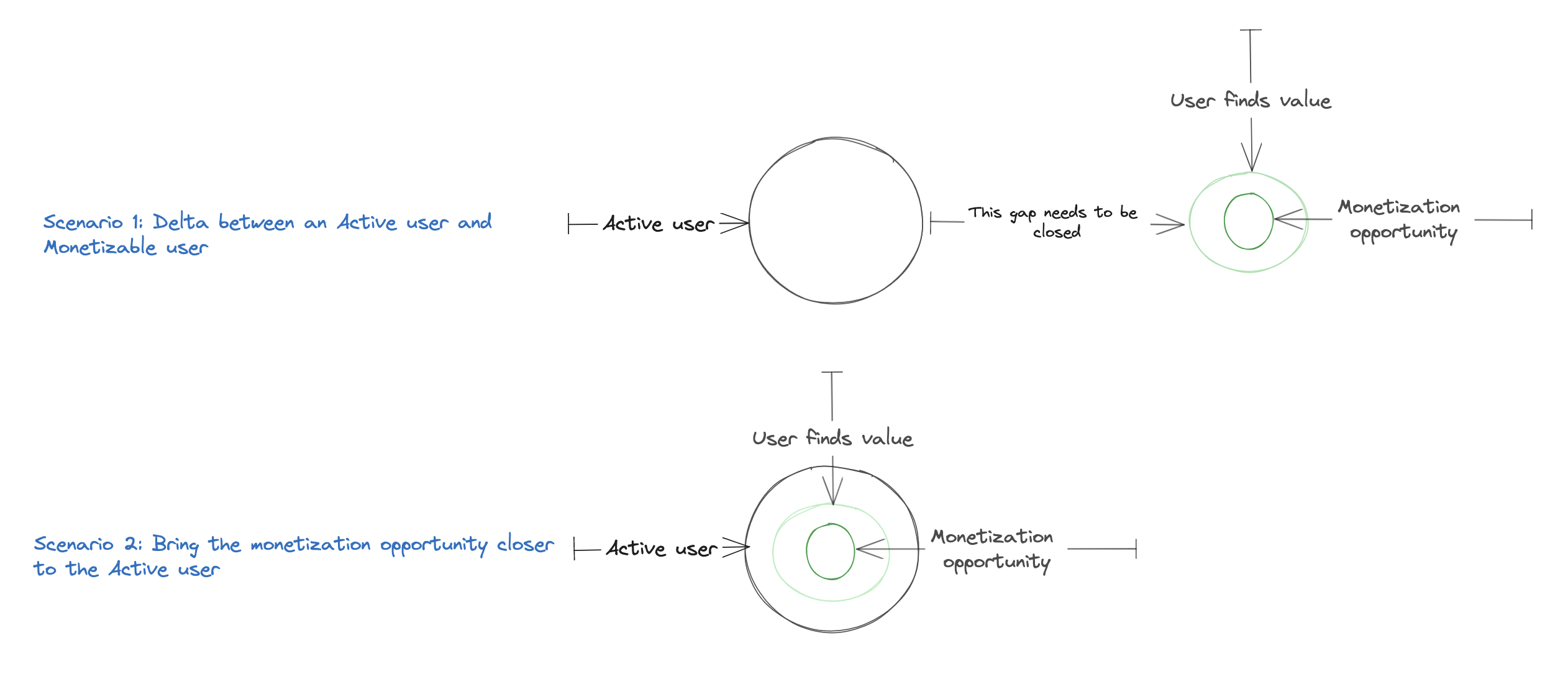
In scenario 1, when Product and Growth teams function separately it’s easy to oversee this gap and let the Growth Activation team to deploy aggressive activation tactics on the monetization opportunity surface whereas in reality fewer Active users are getting to this surface. The wider the gap the harder it gets to convert to monetized user.
In scenario 2, the monetization opportunity is closer to where Active users spend time. Inherently this increases the user base both quantitatively and qualitatively to run monetization experiments.
The simple takeaway here is -
💡 Once you’ve identified the differentiating value your Product offers to users bring the monetization step right next to it.
With some of these basic fundamentals out of the way, let’s dive into the second part: Growth Platform that covers the foundational technical investments required to grow your Product.