In Part 2, we covered the internals of Marketing Operating System (MOS) through three key functional units - Blueprint, Insights Hub, and AI-native CRM. In this article we will leverage MOS to orchestrate context-driven marketing workflows as opposed to silo’ed workflows of sales-led and product-led marketing motions.
Marketing channels
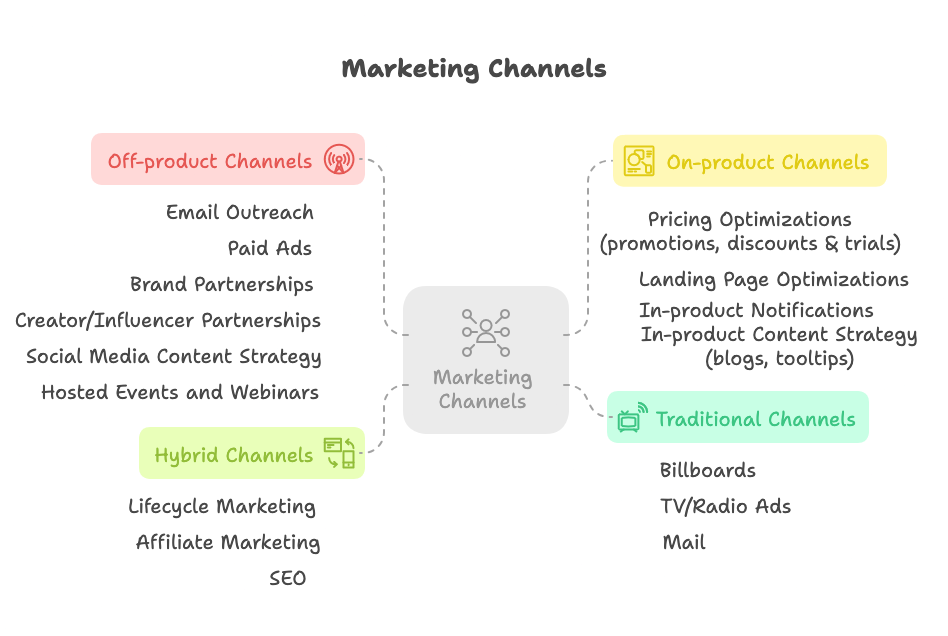
The digital landscape has exploded the number of marketing channels beyond traditional media channels so let’s try to break these down to see how they can leverage MOS.
The thing that is largely consistent across these channels is the semantics of running a marketing workflow – 1. find the right audience, 2. personalize the message, 3. reliable delivery, and 4. sound measurement strategy.
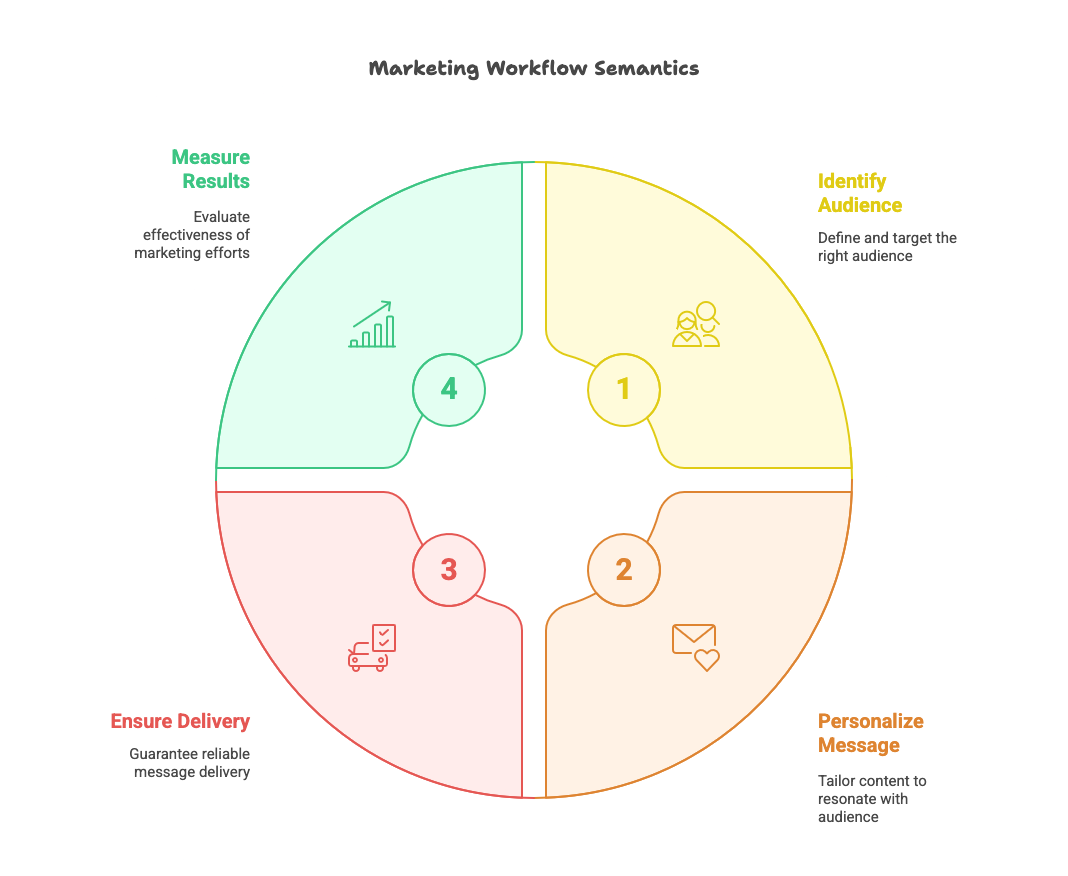
Let’s see how MOS can address each of these steps.
Marketing workflows
1. Find the right audience
This is the top of your funnel and arguably the most challenging step but also has a huge potential to be your differentiator if built right. The spread and quality of the data is what makes it most vulnerable to inefficiencies.
How does MOS solve this
Within MOS, we talked about Insights Hub providing timely and relevant insights that can be tied to an action (workflow) and a way to consume insights beyond the traditional dashboards and reports (natural language queries and smart notifications). Rather than relying entirely on users to come up with search filters for their audience, Insights hub can deploy ML models (lookalike models, churn prediction, win-back prediction, re-targeting models) by combining signals with human in the loop to generate high precision audience targets.
2. Personalization
Sending the right message at the right time plays a huge role in boosting the efficiency of a marketing strategy. For e.g. predicting the company has a GTM moment coming up and personalizing the message to show the value add your product provides for GTM strategies specifically has far more potential for conversion than a generic message that talks about the ten other capabilities your product offers.
How does MOS solve this
Personalization doesn’t just end there. Let’s say you’ve identified email outreach is the most effective channel for your message you need to know the right contact to email within the company (there could be a new GTM head that joined in the last week)
It starts with having a unified source of truth of the company with high quality and relevant signals and this is where the AI-native CRM wing of MOS can be a differentiator. In addition to relying on humans to update data manually and deploying custom integrations to keep the data up to date, a AI-native CRM is always working in the background by building context periodically with signals and self correcting to preserve the integrity of the signals
3. Reliable Message Delivery
In mature organizations at any given point there ought to be multiple marketing strategies deployed with varied levels of complexity. It’s possible a user is exposed to more than one workflow leading to incoherent messaging or workflows silently failing due to system crashes or regressions in the quality of the outcomes.
How does MOS solve this
Workflow Executor within Blueprint is the control plane that orchestrates the workflows. It can regulate the workflows by allocating the right amount of resources, maintain telemetry for each step on the workflow, checkpoint state and gracefully restart on failures.
4. Sound measurement strategy
Traditional marketing tools fall short by only measuring the first line of metrics (ad impressions, email clicks, prospects contacted, etc.) and fail to capture the impact to a business outcome or objective
How does MOS solve this
Blueprint within MOS is an abstraction of multiple marketing workflows that are purpose built for a business objective. From the outset the business objective is translated to one tangible goal metric that is measurable and trackable such as revenue, conversions, retention, etc. Achieving this goal metric is the indicator of a successful marketing strategy for MOS.
With that said just having a dotted line that tracks the goal number is not sufficient as a sound measurement strategy. Marketing involves trying out multiple approaches, iterate and learn quickly and adapt to course correct ahead of time. In other words it requires experimentation (A/B testing) to infer any causal relationships to prove a hypothesis. Learnings from one experiment could potentially inform the next marketing strategy.
However running experiments can be cumbersome and incur tech debt but embedding an experimentation toolkit into the workflow executor provides a low/no-code environment to run experiments seamlessly.
Example: How a Unified Marketing Platform (MOS) Supercharges Growth
To tie all this together it’s worth going over a marketing workflow that blends both sales led and product led marketing motions as one cohesive strategy. After all this was the promise of a unified marketing platform
Imagine you’ve just launched a new product — a spend management tool for corporate expenses. Your website allows users to sign up with their email and onboard by connecting their existing spend tools (such as Brex, Concur, or spreadsheets). Once onboarded, customers receive a personalized dashboard showing their cash inflows and outflows, along with tailored suggestions to optimize expenses.
With your product live and a handful of users onboarded through word of mouth, your next objective is to find and convert new users.
You have a one-person sales team: Alice. Using MOS, Alice searches for potential prospects by entering: “Show me customers in the US with $10M ARR who are Brex users.” MOS quickly returns a best-effort list of companies and contacts — ensuring these prospects are not already existing customers.
Meanwhile, among the word-of-mouth users, several people signed up but did not complete onboarding. Because MOS is integrated with your data platform, it identifies these users — gathering context such as where they dropped off, their location, and company information based on their email domain.
MOS, through its Insights Hub, alerts Alice with an actionable recommendation: enrich your initial cold outreach list with these high-intent users who signed up but didn’t finish onboarding. After Alice approves, MOS automatically de-duplicates the combined contacts list and generates a blueprint with two distinct email workflows:
- Users with intent (signed up but didn’t complete onboarding)
- Cold outreach users (new prospects from the Brex search)
Each workflow is designed to achieve a tangible goal: increase the number of onboarded users by x% relative to the baseline — contributing to the overall objective of expanding your users.
MOS’s Workflow Executor takes it a step further by:
- Splitting contacts into experimental groups
- Personalizing marketing creatives based on available context. For e.g. the email copy for “users with intent” workflow would emphasize setting up a call with Alice to finish onboarding whereas the “cold outreach” workflow would emphasize provide free credits to sign-up.
- Delivering emails reliably across both workflows
In the background, MOS moves all contacts into its CRM, maintaining a unified, up-to-date record of each prospect’s journey as they progress through the workflows.
The Blueprint dashboard provides Alice with real-time visibility into the health of each workflow and tracks progress toward the onboarding goal.
In essence, MOS unifies traditionally siloed marketing and sales workflows into a single cohesive, context-driven strategy — blending product-led signals with human-in-the-loop sales actions to accelerate user growth.
💡 Traditional sales and marketing playbooks were designed for a different pace — longer decision cycles, less responsive markets, and delayed actions. Today, Speed wins. Context wins. Precision wins. That’s where MOS changes the game. It doesn’t just unify sales-led and product-led growth — it connects every signal, every sign-up, and every prospect into one powerful, coordinated system. No more siloed efforts — just one powerful, fast context-driven growth engine that actually moves the needle.