Growth/Growth Engineering/Growth Marketing these days are packaged as an enigmatic skill that requires a certain expertise different from traditional Product building. The goal of this article is to debunk this conspiracy and make a case for - If you build it, you should grow it
Let’s start with where does Growth fit today
The typical lifecycle of a product goes from:
Idea → MVP → Go to market (GTM) → Find Product Market Fit (PMF) → Scale.
During the PMF → Scale phase is when companies invest in Growth to accelerate and to achieve a level of scale that can a) show sustainable positive impact to gross margins and b) get ahead of the competition.
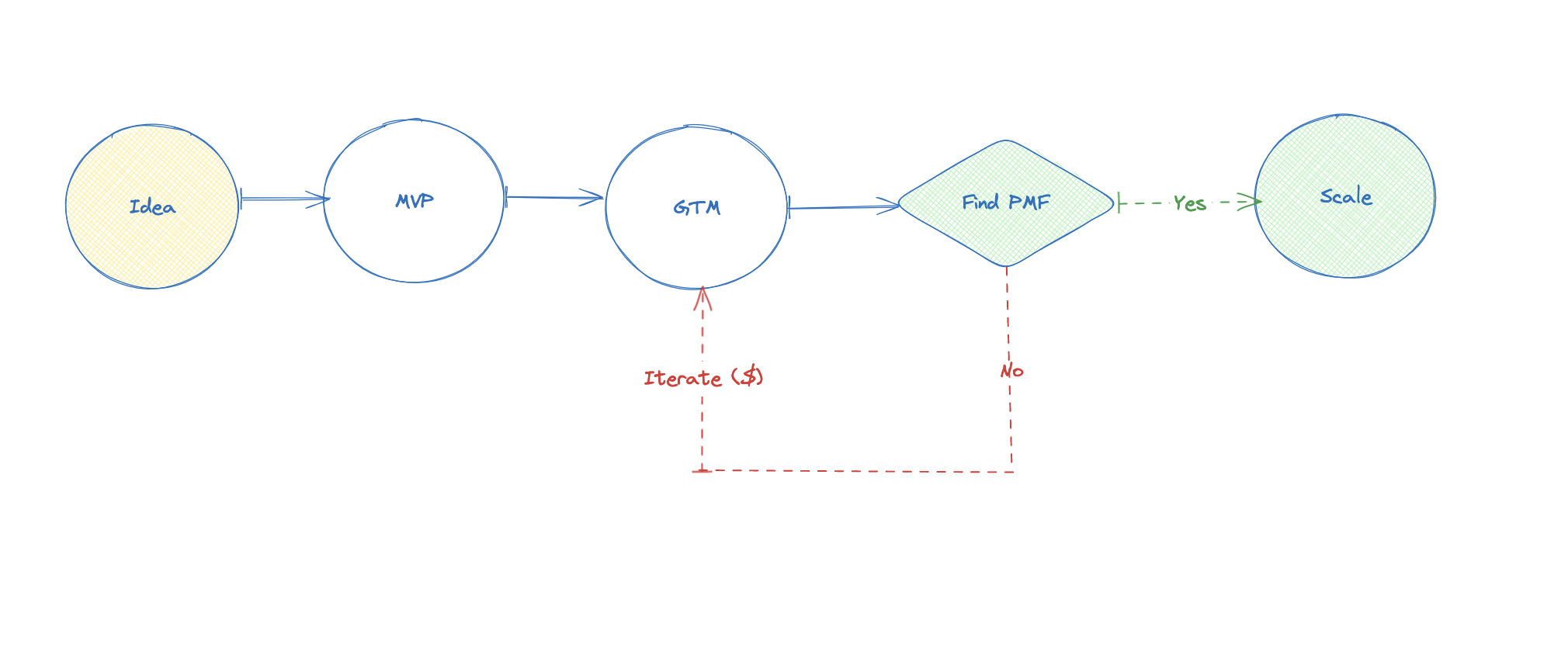
but why is this a problem..
Finding Product Market Fit is hard and understandably so. It’s not a linear equation and can take several iterations to get there either due to no moat, execution failure, disruption in the market from competition or just macro economic climate.
There are a few interesting pitfalls that companies go through in these iterations -
- Start to pivot from core competencies and chase competition to introduce new features/product lines.
- Pivot from listening to their users using data and research for decisions and skew heavily towards intuition and loud voices in the room.
- Introduce tech debt under the disguise of “moving fast”.
- Hiring for the wrong skill sets by focusing more on credentials than folks who really understand the mission and know how to get things done.
- Finally the most important one - burn through a lot of cash.
By the end of all this the product would have achieved Product Market Fit but it comes at a high cost - incoherent product experience, employee burn out, fractured company culture and investor pressure to name a few.
To correct this there is an urgency to accelerate scaling the product to more users and show an impact to net margins and thus enter a new Growth team - a cross functional team of Product Managers, Engineering, Marketing and Data experts. Now unfortunately this new team has very little visibility on the Product journey thus far and also have their own biases on “How to Growth”. The latter, “How to Growth” is the most sought after influencer content (podcasts, newsletters, courses) filled with catchy frameworks, analogies and jargon.
This inevitably leads to creating more friction in the company as ownership lines are blurred, ego clashes, the work gets twice as hard now as a lot of time is spent on planning, driving alignment, defining ownership, OKRs, resource allocation leading to a complete disconnect between Product building and Product growth.
A proposal to fix it..
In this three part series, I want to go back to first principles and cover the Part 1: Fundamentals of Growth and then outline the foundational investments needed for Growth in Part 2: Growth Platform and finally a proposal for an alternative lifecycle where the fundamentals of Growth are embedded from the outset in Part 3: If you build it, you should grow it.